What Is Food Noise? (And Why Do I Think About Food All Day?)
Understanding the constant mental chatter around food


"Why am I thinking about food again?"
Many women describe an exhausting, constant mental conversation that seems to follow them throughout the day. . .
"What should I eat?"
"Should I have that?"
"I've already had too much."
"I'll be good tomorrow."
"Maybe I'll just have one."
"I shouldn't be thinking about food this much."
For many people, this experience has become known as food noise.
And while it can feel frustrating or embarrassing, it is not a reflection of weakness or a lack of willpower.
It is often a learned pattern—one that developed for understandable reasons.
You might recognize food noise if...
You think about your next meal long before you're hungry.
You mentally negotiate what you're "allowed" to eat.
You feel guilty after eating and immediately plan how to compensate.
You spend significant energy deciding whether you "deserve" certain foods.
You feel distracted by thoughts about food even while working or spending time with family.
You wonder why other people seem to eat without thinking about it.
If this sounds familiar, you are far from alone.
Food noise isn't simply hunger
Physical hunger has a purpose.
Your body signals that it needs nourishment, you eat, and eventually those signals quiet.
Food noise is different.
It's often persistent.
It can appear shortly after eating.
It can continue even when you're physically full.
Sometimes it isn't asking for food at all.
Sometimes it's asking for comfort.
Or relief.
Or certainty.
Or rest.

Why does food become so loud?
There is rarely one single reason.
Instead, food noise often develops through years of experiences.

Dieting and restriction
When we repeatedly tell ourselves we cannot have certain foods, our brains naturally pay more attention to them.
Think about what happens when someone tells you not to think about a pink elephant.
Suddenly, that's exactly what your mind notices.
Restriction often increases preoccupation.
When we're overwhelmed, our brains naturally seek ways to feel better.
Food can become one of the quickest and most familiar sources of relief.
Not because we're weak.
Because our nervous system has learned that eating can temporarily reduce discomfort.

Stress and the nervous system
Food may represent:
celebration
comfort
safety
distraction
reward
connection
familiarity
Over time, the brain begins offering food whenever those emotional needs arise.

Emotional associations

Years of self-monitoring
Many women have spent decades tracking calories, counting points, weighing themselves, or evaluating whether they were "good" or "bad."
After years of this constant monitoring, it's understandable that food occupies significant mental space.
The mind has been trained to believe food requires constant attention.
Food noise is not a character flaw
Many people believe,
"If I were more disciplined, I wouldn't think about food this much."
But shame rarely quiets the mind.
In fact, self-criticism often creates more stress, and stress often makes food thoughts louder.
Compassion is not giving up.
It's creating the safety needed for change.
The cycle that keeps food noise alive
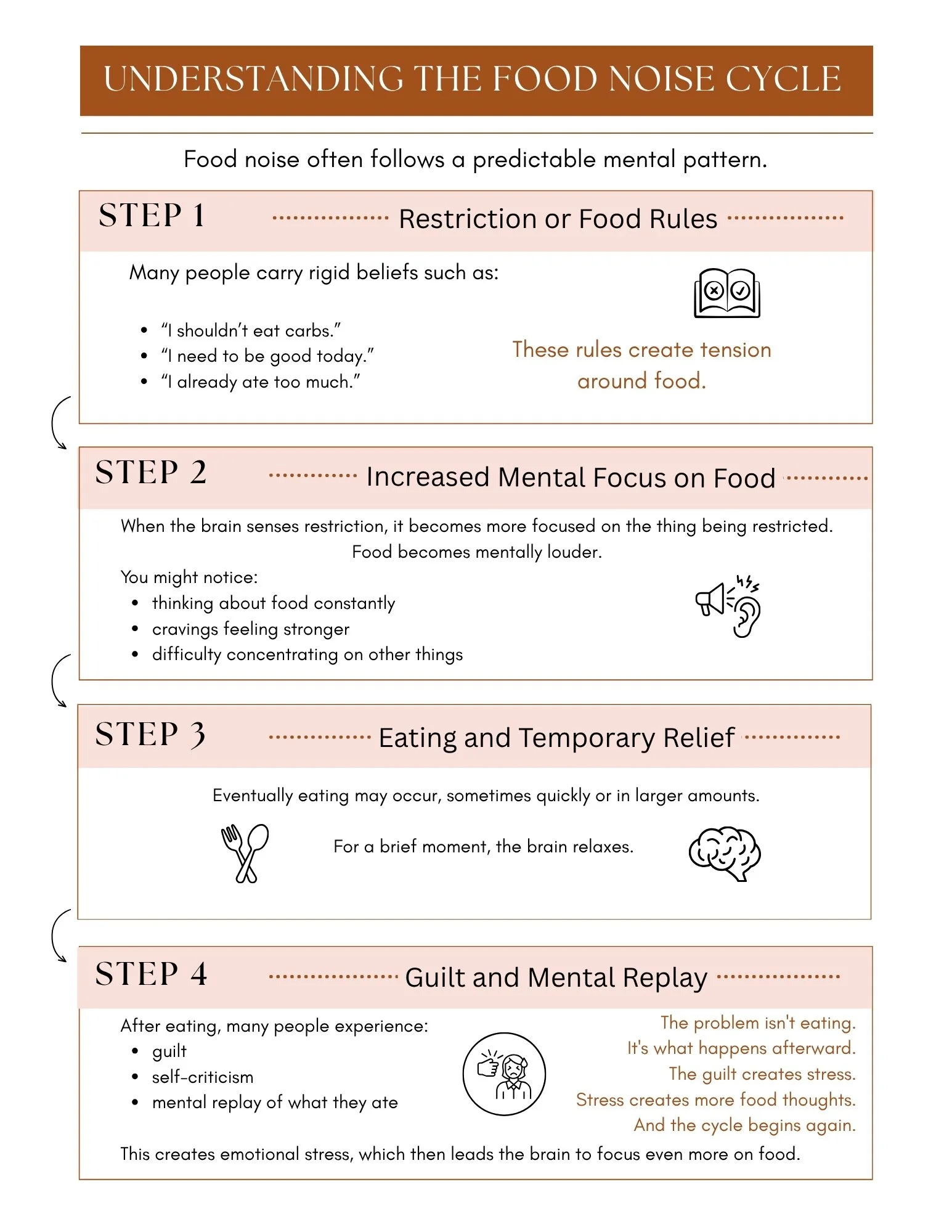
The answer is rarely more control.
Often, it's greater understanding.
What actually helps?
While everyone's experience is unique, many people find it helpful to begin by:
eating consistently throughout the day
noticing rather than judging food thoughts
becoming curious about emotions underneath the urge
supporting nervous system regulation
letting go of all-or-nothing thinking
rebuilding trust with their body
The goal isn't to never think about food.
The goal is for food to take up only the space it needs to nourish your life—not dominate it.

A gentle reflection
There are no right or wrong answers.
Just opportunities to become more curious and compassionate.
Take a moment and ask yourself:
When are food thoughts the loudest?
What was happening just beforehand?
What emotion might my mind or body be trying to soothe?
If food wasn't the answer, what might I actually need right now?

Where should I begin?
If constant food thoughts leave you feeling exhausted, overwhelmed, or stuck, you don't need to solve everything at once.
One gentle place to begin is by learning how to quiet the mental chatter rather than fighting it.
This hypnosis kit was created to help women understand these patterns, calm repetitive food thoughts, and create more space for choice instead of automatic reaction.