Do I Have Binge Eating? (And What if I’m Not Sure?)
You don't have to fit a label to deserve support.


"I don't know if I have binge eating…or if I just have no willpower."
Many women tell themselves...
"I just need more discipline."
"I'm addicted to sugar."
"If I could just stick to a plan..."
"Other people have real eating disorders. I'm just weak."
"I'll start over tomorrow."
If these thoughts sound familiar, you're certainly not alone.
Whatever your experience, you deserve compassion—not judgment.
You don't have to wait until things feel worse before seeking support.
What does binge eating actually mean?
Binge eating is generally described as episodes of eating unusually large amounts of food while feeling a loss of control over the eating.
Some people experience these episodes regularly.
Others experience something that doesn't quite fit that description but still feels deeply distressing.
For example:
feeling unable to stop once you start eating
eating far beyond fullness
eating quickly or secretly
feeling ashamed afterward
repeatedly promising to "be good tomorrow"
feeling consumed by thoughts about food
Whether or not your experience fits a clinical diagnosis, the emotional struggle is real.
This page isn't intended to diagnose an eating disorder. If you're concerned about your eating or your health, it's important to speak with a qualified healthcare professional who can assess your individual situation.
Sometimes it isn't really about the food.
Many people assume their problem is food.
But often, food is simply the strategy their nervous system has learned to use.
Food can temporarily provide:
comfort
distraction
relief
grounding
numbness
predictability
reward
safety
Your brain isn't trying to sabotage you.
It's trying to help you cope using patterns that developed over time.

You might also recognize these experiences:
✓ Constant food thoughts
✓ Feeling guilty after eating
✓ Restricting during the day and overeating later
✓ Starting over every Monday
✓ Feeling "good" or "bad" depending on what you ate
✓ Believing you'll never trust yourself around food
✓ Avoiding social situations because of your body
✓ Feeling exhausted by thinking about food all day
These experiences are incredibly common.
They don't mean you're broken.
They often mean your relationship with food has become tangled with stress, emotion, shame, perfectionism, or years of dieting and self-monitoring.
Why willpower usually isn't the answer
When we believe the solution is simply more control, we often create even more struggle.
Restriction can increase preoccupation.
Shame can increase stress.
Stress often increases the drive to seek comfort.
The cycle can look like this:
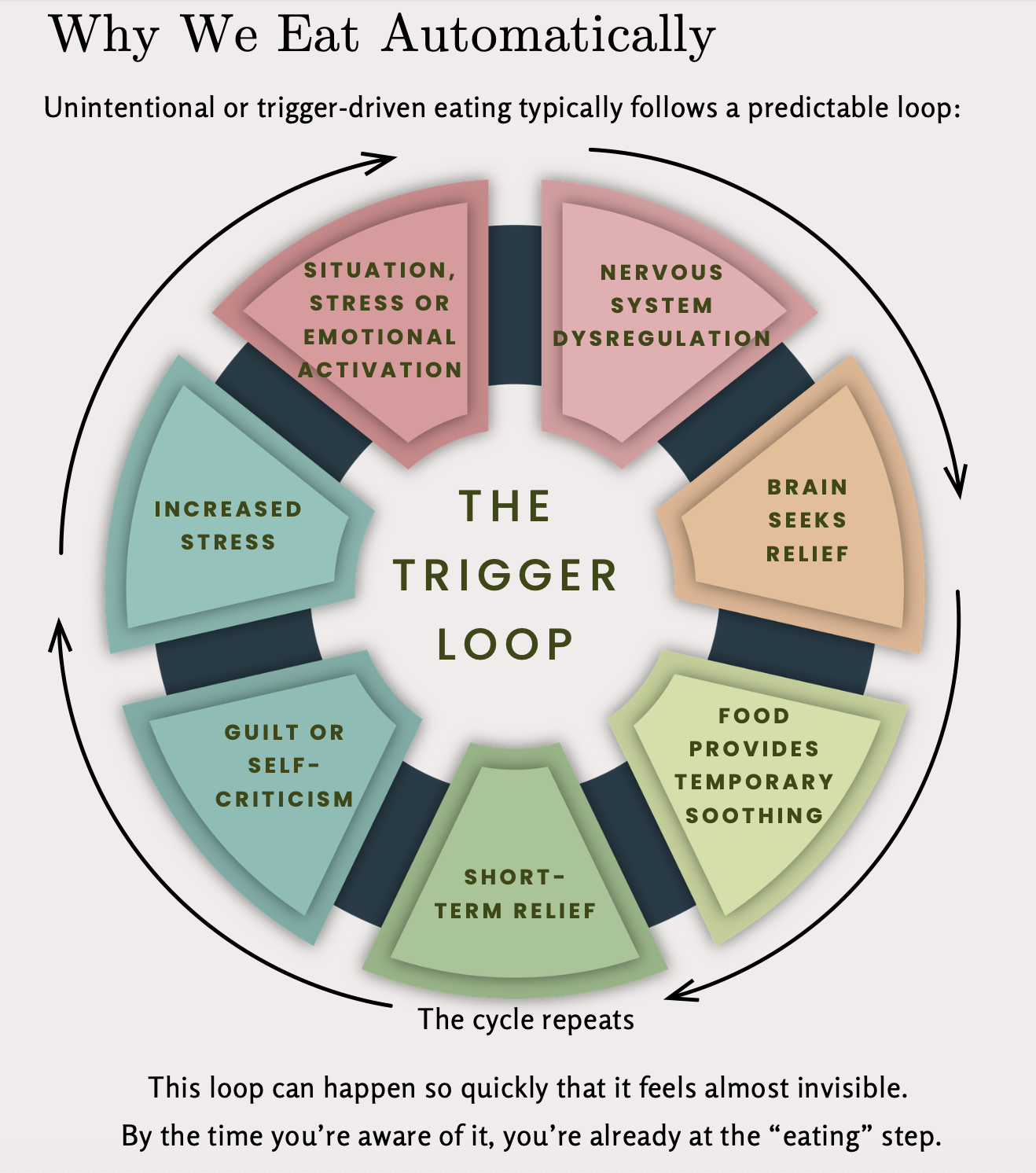
Breaking this cycle usually requires understanding rather than punishment.

Healing isn't about becoming perfect.
It's about becoming curious.
It's learning to notice:
What am I feeling?
What do I need right now?
What story am I telling myself?
Is my body asking for nourishment, comfort, rest, or relief?
Small moments of awareness create opportunities for different choices.
Over time, those small shifts become lasting change.

Where should I start?
If you're feeling overwhelmed, you don't need to fix everything at once.
I've designed my self-guided hypnosis kits to build on one another:
STEP 1
If your mind feels consumed by thoughts about food, this is often the best place to begin.
You'll learn to quiet the constant mental chatter and create more space for choice.

STEP 2
If eating has become your automatic response to stress, overwhelm, loneliness, or difficult emotions, this kit helps you pause and respond differently.

STEP 3
Once you've developed awareness, this kit helps you recognize your personal triggers, regulate your nervous system, and interrupt automatic patterns before they take over.

STEP 4
Many women have spent years fighting their bodies.
This final step focuses on rebuilding safety, self-compassion, and trust so that your body becomes a partner rather than an enemy.
A final thought
You don't have to earn support by struggling more.
You don't have to fit a particular label.
You don't have to wait until you're "bad enough."
If you're tired of fighting with food, your body, or yourself, healing doesn't begin with more willpower.
It begins with understanding.
And sometimes, that understanding is the gentlest and most powerful first step of all.